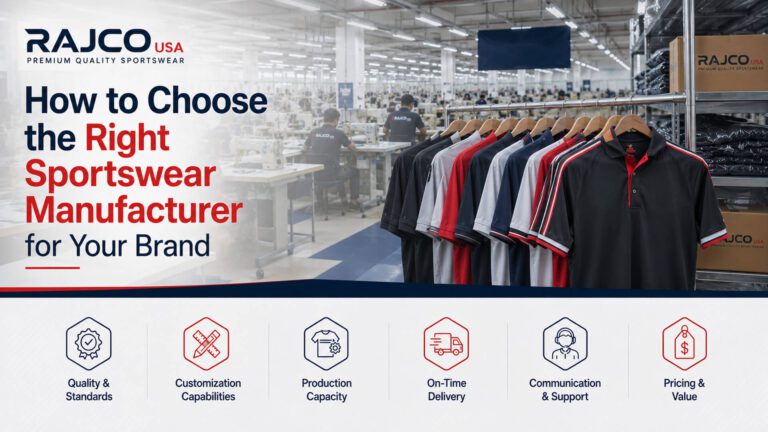
How to Choose a Golf Polo Shirt Manufacturer for Your Brand | 2026 Complete Guide
The Most Expensive Mistake You Can Make as a Golf Apparel Brand
It is not overspending on fabric. It is not underpricing your product. It is not even getting your logo wrong.
The most expensive mistake golf apparel brand founders make is choosing the wrong manufacturer.
A bad manufacturing partner will deliver your polo shirts three weeks late — after your tournament date has passed. They will ship 500 units where 200 come out half an inch shorter than the approved sample. The embroidery will look clean in the photo but pulls and distorts after the first wash. The fabric pills after three rounds.
And when you try to reach them to resolve it, communication goes cold.
That is not a hypothetical horror story — it is a pattern that destroys brands at every stage, from first-time founders placing their first 100-piece order to established wholesale buyers managing $200,000 seasonal orders.
This guide exists to make sure it does not happen to you. Here is exactly how to choose the right golf polo shirt manufacturer for your brand in 2026 — what to look for, what questions to ask, what red flags to walk away from, and what the best partnerships actually look like.
Step 1 — Get Completely Clear on What You Actually Need

The biggest sourcing mistake brands make is approaching manufacturers before they know what they are looking for. Before you contact a single supplier, answer these questions:
What Type of Product Are You Making?
Golf polo shirts exist across a wide spectrum. Knowing where you sit determines which manufacturers are even relevant to you:
- Performance polo shirts for serious players: prioritize moisture-wicking fabrics, UPF protection, 4-way stretch
- Lifestyle/fashion golf polo shirts: prioritize design, color range, and trend-forward styling
- Corporate golf polo shirts: prioritize consistent sizing, professional finish, embroidered branding
- Club merchandise polo shirts: prioritize brand accuracy, premium presentation, reorder reliability
- Tournament polo shirts: prioritize fast turnaround, sublimation capability, budget management
What Is Your Target Price Point?
A $25 retail polo and a $120 retail polo require very different manufacturing decisions. Be honest about your budget before you start requesting quotes, or you will waste both your time and the manufacturer’s time.
What Volume Are You Starting With?
Your first order quantity determines which tier of manufacturer you can realistically work with. If you are starting with 100 pieces per style, you need a manufacturer with low MOQ flexibility. If you are buying 2,000 pieces per style from the start, you have more options.
What Customization Do You Need?
- Sublimation printing (all-over pattern/color)
- Embroidery (logo, text, raised texture)
- Screen printing (chest logo, sleeve graphic)
- Private label branding (custom neck labels, hang tags, packaging)
- All of the above
Knowing your customization requirements upfront eliminates manufacturers who cannot deliver them.
Step 2 — Understand the Three Manufacturing Models

Before you evaluate any golf polo shirt manufacturer, understand the three production models that exist and which one fits your business:
OEM (Original Equipment Manufacturing)
You provide the complete design specification — tech pack, measurements, fabric details, color codes, branding placement — and the manufacturer produces exactly what you specify.
Best for: Brands with in-house design capability, established brands expanding their line, buyers with specific performance specifications
Pros:
- Complete creative control
- Product is exactly what you design
- No overlap with other brands using the same base styles
Cons:
- Requires detailed design documentation (tech packs)
- Higher sampling investment before bulk production
ODM (Original Design Manufacturing)
The manufacturer has existing designs and patterns. You choose from their catalog, modify elements (color, fabric, logo placement), and brand the finished product as your own.
Best for: Startups launching quickly, brands without in-house design teams, buyers who need to move fast
Pros:
- Faster to market — no design-from-scratch process
- Lower development cost
- Proven patterns with known fit and construction
Cons:
- Less unique — other brands may use similar base styles
- Less control over specific design details
Private Label Manufacturing
The manufacturer produces finished, branded garments under your brand name entirely. This includes manufacturing, branding, labeling, and packaging — all delivered ready to sell.
Best for: E-commerce brands, retailers building exclusive collections, brands that want a complete retail-ready product
Pros:
- Complete end-to-end production
- Your brand on every element — labels, packaging, hang tags
- Simplest buying experience
Cons:
- Higher per-unit cost than unbranded bulk
- Less control over manufacturing details
Understanding which model suits your business makes every subsequent conversation with a manufacturer far more productive.
Step 3 — Evaluate Manufacturer Type: Direct vs. Trading Company

This is one of the most important distinctions in apparel sourcing — and one that many brands miss until they are already in a problem order.
Direct Manufacturers
A direct manufacturer owns and operates its own production facility. They have machines, operators, quality control staff, and production management all under one roof.
Advantages of direct manufacturers:
- Lower pricing — no broker markup
- Faster communication — you deal with people who can actually make decisions
- Real production visibility — you can request factory audits, live updates, production photos
- Accountability — problems can be addressed directly with the people responsible
- Consistent quality — you build a relationship with a specific production team
Trading Companies / Agents
A trading company does not manufacture anything. They act as middlemen between you and a factory — often one they have no long-term relationship with. They take a margin on your order and often have limited control over what actually happens in production.
Red flags for trading companies:
- Cannot answer detailed technical questions about production
- Vague or evasive about their factory location and capabilities
- Unable to arrange a factory visit or video audit
- Prices seem suspiciously low compared to direct manufacturers
The rule: Always ask directly — “Do you own and operate your own manufacturing facility?” and “Can I visit or arrange a video tour of your production facility?” A direct manufacturer will answer yes to both without hesitation.
Step 4 — Assess Fabric & Technical Capability

For custom golf apparel, fabric is not a secondary consideration — it is the product. Golf polo shirts are performance garments. They need to do specific things:
Essential Performance Requirements for Golf Polo Shirts
Moisture-Wicking Golf is a four-hour outdoor activity. Your polo shirts need to pull sweat away from the skin and disperse it across the fabric surface for rapid evaporation. Ask your manufacturer specifically which moisture-wicking fabric technology they use and request test data or fabric specifications.
UPF Sun Protection Golfers are exposed to direct sun for extended periods. UPF-rated polo shirts — typically UPF 30+ or UPF 50+ — provide meaningful protection against UV radiation. This is an increasingly important feature for both performance and product marketing.
4-Way Stretch A golf swing requires full rotational movement through the shoulders, torso, and hips. Polo shirts made from 4-way stretch fabric (typically polyester-spandex blends) move with the body and return to their original shape — critical for both comfort and performance.
Quick-Dry Technology Fabrics that dry quickly keep players comfortable throughout the round. Standard cotton absorbs moisture and holds it — which is why performance golf polo shirts rarely use 100% cotton as the primary fabric.
Anti-Odor Treatment Premium golf polo shirts often include anti-bacterial or anti-odor fabric treatments — especially important for shirts worn during active play.
Questions to Ask About Fabric Capability
- What are your standard performance fabric options for golf polo shirts?
- Can you provide fabric composition details and GSM specifications?
- Do you offer UPF-rated fabrics? What UPF ratings are available?
- Can you source sustainable or recycled fabric options?
- Do you have fabric swatches you can send before we commit to sampling?
A manufacturer who cannot answer these questions confidently does not have the technical expertise to produce quality golf performance apparel.
Step 5 — Evaluate Customization Capability

The customization method you choose has a major impact on your product’s look, durability, cost, and manufacturing timeline. Here is what to know about each option:
Sublimation Printing
The gold standard for custom golf apparel with all-over patterns, bold designs, or full-color sponsor branding. Sublimation bonds the dye directly into the polyester fabric fibers — the design becomes part of the fabric, not a coating on top of it. It will never crack, peel, or fade.
Ask: Do you offer full-coverage sublimation? What is your resolution capability? Can you match Pantone colors?
Important: Sublimation only works on polyester (or high-polyester blend) fabrics. It is not suitable for 100% cotton polo shirts.
Embroidery
The premium choice for golf club merchandise, corporate polo shirts, and private label collections where a textured, high-quality brand mark is important. Professional embroidery holds its appearance through hundreds of washes.
Ask: Do you have in-house embroidery capability? What is the maximum stitch count per design? Can you do 3D puff embroidery?
Screen Printing
Cost-effective for chest logos, sleeve graphics, and 1–6 color prints on large order quantities. Screen printing sits on top of the fabric surface — quality printing includes proper underbase layers for durability.
Ask: What printing inks do you use? Do you offer discharge printing? What is the minimum order for screen printing?
Private Label Branding
This goes beyond garment customization into full brand packaging:
- Custom neck labels (woven, printed, or heat-transfer)
- Branded hang tags (paper, plastic, premium materials)
- Woven brand badges
- Size labels meeting FTC requirements
- Custom poly bags or retail packaging
Ask: Do you handle all labeling in-house or do you outsource it? Can I see examples of previous private label orders?
Step 6 — Ask the Right Questions About MOQ and Pricing

MOQ is often the deciding factor for brands at the startup stage. Here is how to approach it intelligently:
Understanding MOQ
MOQ (Minimum Order Quantity) refers to the minimum number of units a manufacturer requires per style or per colorway to accept an order. MOQs exist because manufacturing economics only work at certain volumes — cutting and sewing infrastructure, thread setup, ink mixing, and sampling costs are spread across the units in each run.
Typical MOQ ranges for golf polo shirt manufacturers:
- Small/flexible manufacturers: 50–150 pieces per style
- Mid-size manufacturers: 200–500 pieces per style
- Large-scale manufacturers: 500–1,000+ pieces per style
Negotiating MOQ as a New Brand
If you are a new brand and a manufacturer’s standard MOQ is higher than your initial order size, here are legitimate strategies:
- Pay a higher per-unit cost in exchange for a lower MOQ — many manufacturers will accommodate this
- Consolidate colorways — instead of 5 colors at 50 units each, try 2 colors at 125 units each to hit the MOQ
- Start with one style — prove your business before expanding your range
Pricing Red Flags
Be wary of:
- Pricing that is dramatically lower than all other quotes you receive — it usually means a quality or compliance shortcut somewhere
- Manufacturers who refuse to provide itemized pricing breakdowns
- Quotes that don’t include sampling costs — samples should always be part of the conversation upfront
Step 7 — Verify the Sample Process

The sample process is your last line of defense before committing money to bulk production. Never skip it.
What a Proper Sample Process Looks Like
Stage 1 — Development Sample (Fit Sample) The manufacturer produces the first physical version of your garment. This sample checks fit, construction, and fabric — but may not include final branding. You review and provide feedback.
Stage 2 — Pre-Production Sample (PPS) After fit approval, the manufacturer produces a sample with all final details: correct fabric, correct color, correct branding, correct labels. This is the exact product you are approving for bulk production.
Never approve bulk production based on a development sample only. Always get and approve a pre-production sample with all final specifications before releasing your bulk order.
Sample Costs
Most manufacturers charge for samples — typically between $50–$300 per sample depending on complexity. Some manufacturers refund the sample cost against your first bulk order. Always ask upfront.
Red flag: A manufacturer who does not charge for samples may be sending you existing stock rather than custom-made samples built to your specifications.
Step 8 — Assess Lead Times Realistically

Lead time is the total time from order placement to goods in your hands. For golf polo shirt manufacturing, realistic lead times typically break down as:
| Stage | Typical Time |
| Consultation & brief | 1–3 days |
| Fabric sourcing | 3–7 days |
| Sample development | 7–14 business days |
| Sample review & approval | 3–7 days |
| Bulk production | 15–30 days (depends on volume) |
| Quality inspection | 2–5 days |
| Shipping (USA domestic) | 2–5 days |
| Shipping (international air) | 3–7 days |
| Shipping (sea freight) | 15–35 days |
Total realistic timeline from first contact to delivery: 6–12 weeks for a first order.
Plan your inventory and launch timeline around these realities — not around optimistic promises. Any manufacturer who guarantees a bulk custom order in two weeks without a pre-existing relationship is either not telling the truth or cutting corners on quality control.
Step 9 — Check for USA Market Compliance Knowledge

If you are selling golf polo shirts in the USA, your products must comply with specific regulations. Your manufacturer should be familiar with all of them:
FTC Care Labeling Rule All clothing sold in the US must include care instructions. Your manufacturer should understand how to produce care labels that meet FTC requirements — including fiber content disclosure, country of origin, and washing instructions.
CPSC Requirements If you are producing children’s golf apparel (youth sizes), CPSC safety testing requirements apply. A USA-experienced manufacturer will know this.
Sizing Standards US sizing conventions (S, M, L, XL, etc.) differ from Asian sizing standards. Make sure your manufacturer builds patterns to US body measurement standards, or size discrepancies will cause significant customer service problems.
Step 10 — Red Flags to Walk Away From
After hundreds of conversations with apparel brands about manufacturing problems, here are the warning signs that consistently precede bad manufacturing experiences:
🚩 No factory visit, no video audit, and resistance to both — Legitimate manufacturers welcome scrutiny of their facilities. Resistance is a major warning sign.
🚩 Vague answers to technical questions — If a manufacturer cannot tell you the GSM of their fabrics, the stitch count for embroidery, or the specific polyester grade they use, they do not have genuine technical expertise.
🚩 Pressure to skip samples — “Our quality is guaranteed, you don’t need a sample” is a phrase used by manufacturers who know their product will not meet your expectations.
🚩 All-in-one promises with no specifics — “We can do anything” without specific capability details often means “We will find someone else to do it and add a margin.”
🚩 No references or case studies — Any manufacturer with a real track record will have client examples they can point to. If they cannot provide any references, ask why.
🚩 Communication delays before the order — If it takes four days to get a reply to your initial inquiry, imagine how long it takes when there is a production problem.
The Checklist: How to Evaluate Any Golf Polo Shirt Manufacturer
Use this checklist when evaluating any golf polo shirt manufacturer:
Business Basics
- Are they a direct manufacturer or a trading company?
- How long have they been in business?
- Where are they physically located?
- Can you visit or arrange a video tour of their facility?
Technical Capability
- What performance fabrics do they offer (moisture-wicking, UPF, stretch)?
- Can they produce to your fabric specifications?
- What customization methods do they offer in-house?
- Do they have in-house embroidery, sublimation, and screen printing?
MOQ & Pricing
- What is their MOQ per style?
- Do they offer flexible MOQ for first orders?
- Will they provide an itemized quote?
- What do samples cost, and is the cost refunded against bulk?
Process & Communication
- What is their sample development timeline?
- Do they provide pre-production samples for approval?
- What is their bulk production lead time?
- Who is your dedicated point of contact?
- How responsive are they during the inquiry process?
US Market Knowledge
- Are they familiar with FTC care labeling requirements?
- Do they build to US sizing standards?
- Can they handle US-compliant private label branding?
Why Rajco USA Checks Every Box
If you have worked through this guide, you now know exactly what the right golf polo shirt manufacturer looks like. Rajco USA was built to check every single one of those boxes.
Direct manufacturer since 1935 — based in Brooklyn, New York, with 90+ years of continuous sportswear manufacturing experience. No agents, no middlemen, no brokers.
Full performance fabric capability — moisture-wicking polyester, 4-way stretch polyester-spandex blends, UPF-rated fabrics, pique, interlock, and recycled RPET for sustainable collections.
Complete in-house customization — sublimation printing, embroidery, screen printing, heat transfer, silicone logos, and full private label branding including custom neck labels, hang tags, and retail packaging.
Flexible MOQ — supporting startups on their first small run and established wholesalers managing large seasonal production with equal commitment and quality.
US market expertise — FTC labeling compliance, US sizing standards, and direct communication with US-based buyers are part of how we work every day.
Transparent process — consultation, fabric sourcing, sample development, pre-production approval, bulk production, quality inspection, and packaging under one roof with one dedicated account manager throughout.
FAQ’S
How do I find a reliable golf polo shirt manufacturer in the USA?
Start by verifying whether the supplier is a direct manufacturer or a trading company. Request a factory tour or video audit. Ask detailed technical questions about fabric and customization capability. Always require a pre-production sample before approving bulk production.
What should I look for in a custom golf apparel manufacturer?
Look for performance fabric expertise, in-house customization capability (sublimation, embroidery, private label), flexible MOQ, transparent pricing, a clear sample process, and proven experience with US market compliance requirements.
How much does it cost to manufacture custom golf polo shirts?
Costs vary significantly based on fabric choice, customization method, and order quantity. Per-unit costs decrease as order volume increases. Request itemized quotes from at least three manufacturers to benchmark pricing accurately.
What is private label polo shirt manufacturing?
Private label manufacturing means a manufacturer produces polo shirts that are branded entirely under your name — your labels, hang tags, and packaging — ready to sell as your own product. Rajco USA provides complete private label polo shirt manufacturing for brands, retailers, and e-commerce businesses.
How long does it take to manufacture golf polo shirts?
From initial consultation to final delivery, a typical custom golf polo shirt order takes 6–10 weeks including sample development, approval, bulk production, quality inspection, and shipping.
What is the difference between OEM and private label golf polo shirt manufacturing?
OEM means you provide your own designs and the manufacturer produces them. Private label means the manufacturer produces the garments and you apply your branding. Both result in products sold under your brand — the difference is who controls the design process.